Yachting World Feature: Extraordinary Boats
Back in April, journalist Ali Wood was here in the BVI covering the BVI Spring Regatta. Looking for interesting extra stories she tracked us down, and this is the result: a great feature on Triple Jack in one of our favourite reads, Yachting World
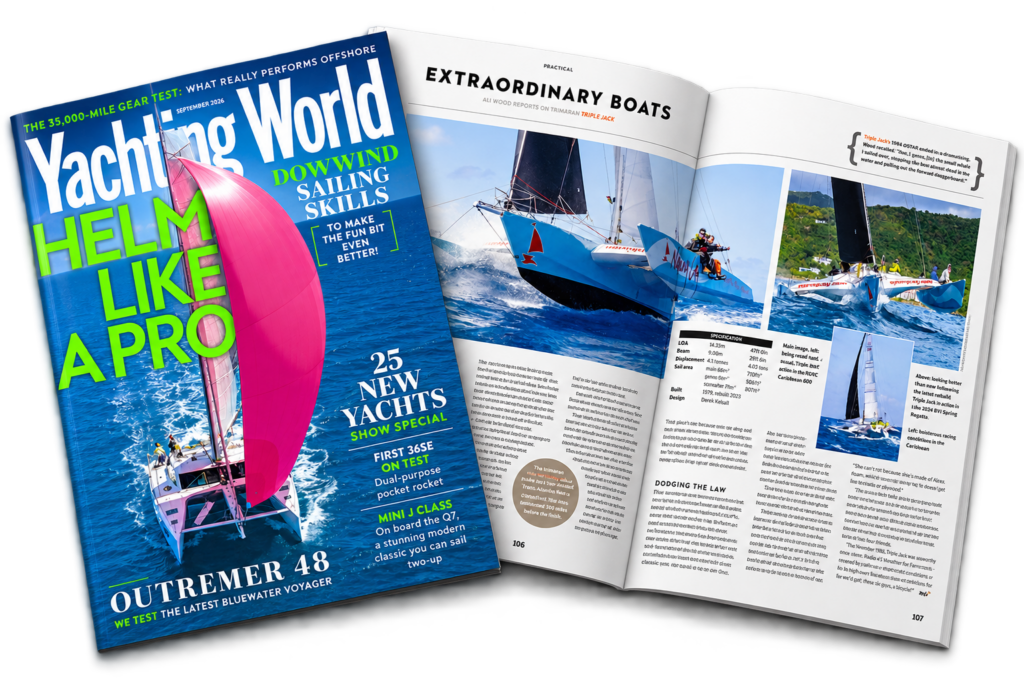
Read the article below or click on the image above for all the words and pictures in the September issue of Yachting World as a PDF [or click here]
Yachting World, September 2026
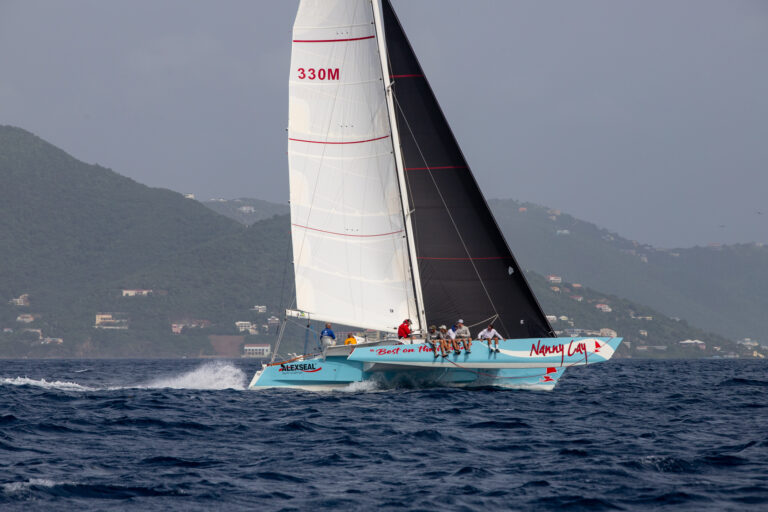
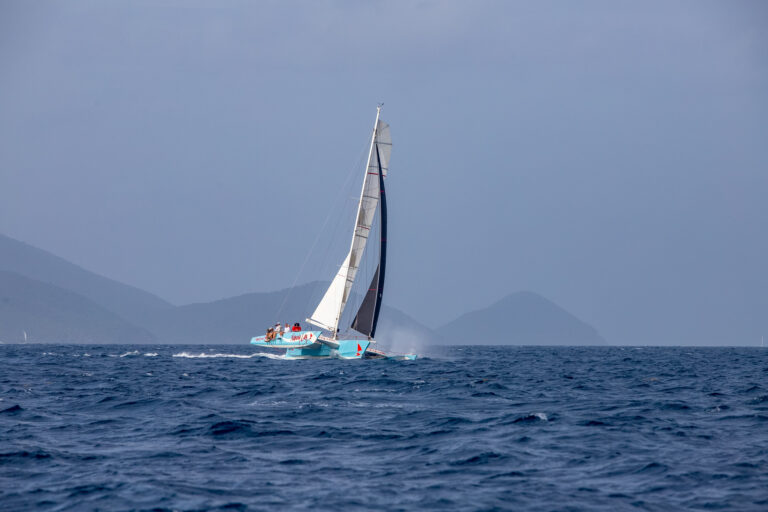
Triple Jack is a 1979 Kelsall trimaran with a chequered history that includes being near-wrecked by Hurricane Irma and rebuilt.
Cats have nine lives, they say, but this trimaran has 10. Now moored in Nanny Cay, in the British Virgin Islands, with its blue and red livery and retro bow shape, Triple Jack stands out among the surrounding production cruisers. By rights Triple Jack should not even be here. Twice dismasted, detained in Portugal, and thrown across the bay by Hurricane Irma, she refuses to meet her maker.
Designed by the late multihull pioneer Derek Kelsall, the 47ft trimaran was built in the UK by Frank Wood and sons for the 1981 TWOSTAR, in the days when multihull racing was in its infancy. Impressed by Kelsall’s foam sandwich Toria – which won the 1966 Round Britain and Ireland Race – Wood requested something similar, and so Triple Jack was conceived. A year later, to the astonishment of onlookers, the hull popped out from the second floor of a Manchester mill.
Fast forward four decades, and Frank Wood’s son, Jeff, happened to be chartering in the BVI when he came across Triple Jack, the boat he helped his father build. He hurried to the nearest bar and asked who she belongs to.
“Why, that would be me,” replied barman Steve Davis who, together with friend Richard Wooldridge, has owned the boat for 30 years. “Fancy a sail?”
And so the trio headed out for the turquoise waters of Tortola where Davis and Wooldridge updated him on the extraordinary decades between a young Jeff crawling into the sponsons to glass his father’s boat, and Triple Jack becoming a Caribbean title holder.
The story begins in Exmouth, Devon, when college pals Davis and Wooldridge ran a sailing school in the late 1980s. Moored on the River Exe was ‘a mess of a trimaran’.
“Docklines verdigrised into the paintwork, a whole coil of weeds hanging off her and cormorant s**t everywhere,” recalls Wooldridge.
What they didn’t realise was that this sorry-looking yacht had, in fact, made it across the Atlantic – albeit finishing the 1981 TWOSTAR race without a mast, and attached by its anchor warp to a freighter.
Wooldridge explains: “Frank Wood and his brother-in-law Michael Hampson were determined to cross the finish line. The freighter was Newport-bound anyhow, so it basically lifts Triple Jack up, sends them over the edge, and the whole cradle breaks. They’re free-falling, stern-first into the water, but they get over the line – and they get the picture!”
The pair escaped unscathed and received Yachting World’s Imperturbability Award from journalist Geoff Hale.
DODGING THE LAW
Wood commissioned a new mast from Hall Spars, Newport, and in 1984 attempted to cross the Atlantic again in the single-handed OSTAR… only to be dismasted once more. This time rescued by the Portuguese Navy, he was towed into then near-communist Portugal without documentation – the tow paid for by sponsors Marsden Building Society. After a failed attempt to pass off the pressure cooker warranty as the ship’s papers, Triple Jack was detained, but Wood gained permission to work on her. Once she was shipshape, the story goes that he bribed a port official to tow him away in the middle of the night, and escaped over the border to Spain.
“Frank Wood is the last of the English eccentrics,” says Steve. “I believe he’s still floating around Florida somewhere on his boat.”
Done with racing, Wood sold Triple Jack to a dealer in 1987 and she ended up in the hands of an owner who, due to unforeseen circumstances, left her to languish on the River Exe.
Having sailed past the trimaran many times, curiosity got the better of Davis and Wooldridge, so they climbed aboard and found the boat unlocked. They traced the owner via a VHF renewal request, and discovered it was ex-racer Triple Jack. Impressed with her lineage, they offered to fix up the trimaran in exchange for being allowed to sail it.
“There was a mussel bank underneath, but she wasn’t rotten,” recalls Wooldridge.
“She can’t rot because she’s made of Airex foam, which was popular back then. Water doesn’t get in like it does with balsa or plywood.”
However, the mast step was giving way, and the decks buckling. Triple Jack was dangerous, and in no fit state to be sailed, so they spent the best part of a year working on the boat.
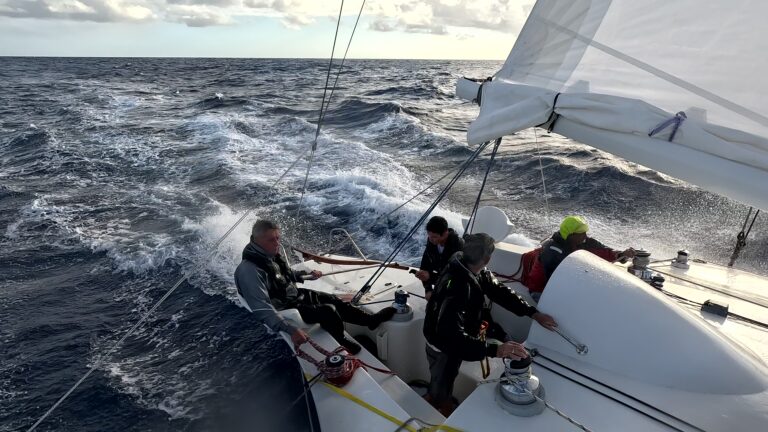
By November 1988, Triple Jack was seaworthy once more. Radio 4’s Weather for Farmers – much revered by sailors – predicted north-easterlies and a big high over Biscay. Perfect conditions for a sail to the Canaries… with four friends.
“The Beach Hotel at that time was a sailors’ pub,” says Wooldridge. “They had a sweepstake on how far we’d get; these six guys, a bicycle and a stupid amount of gear (including a spare mainsail and winches) on a boat designed for two. They thought we were out of our minds.”
“I realised, when I failed to push her off the wall at Exmouth docks, that we were overloaded,” adds Davis.
Nonetheless, they set sail and were “blown to Finisterre without much bother.” But then things took a turn for the worse.
“We couldn’t furl the big genoa, it was dark, we were overpowered and the old front beams were like sea shovels, collecting loads of water and sending it back,” recalls Wooldridge. “We were in danger of pitchpoling, and had a crew in the sponson continually bailing.”
To make matters worse a freighter shed its cargo of mahogany logs, which they discovered the following morning, and had to weave around.
“We did get hold of one and considered selling it, but it was slimy and ridiculously heavy. We soon abandoned that idea,” laughs Wooldridge.
Instead, they made their money another way; by setting up a yacht charter in the Canaries. The customer-base – mainly hippies and young travellers – were in for quite the ride, given that Triple Jack’s mainsail had come from a monohull (lacking the correct roach and full length battens) and had a ‘seriously scary’ oversized spinnaker.
After being shooed away by the locals, who objected to this illicit day-sail business, Wooldridge and Davis moved around the Canaries until they ran out of islands. They returned to Exmouth and put Triple Jack on a mooring, but one day after a storm, received the news she was wedged under a bridge 10 miles upriver. All three bows were broken.
Triple Jack was uninsured and repairs would be costly. If the friends were to put the time into fixing her up, this time they wanted ownership. By now it was 1995 and the owner, who had purchased the boat from Wood via a dealer, agreed and sold her to them for £5,000.
They decided to restore her to RORC Cat 3 racing spec, and funded the work through boat deliveries, which is how in 1994 Wooldridge came to be offered a job managing a charter fleet in the BVI. Davis joined him some years later – opening a bar and guesthouse on Tortola – and in 1997 they took Triple Jack across the pond and threw themselves into the Caribbean racing scene.
“We joined the BVI Yacht Club and did the Spring Regatta, but nobody knew how to handicap us,” says Wooldridge, as the race fleets of the day were made up of monohulls.
But by the noughties, Triple Jack was joined by an increasing number of French multihulls, and giving these more modern contemporaries a run for their money. It won most major Caribbean regattas, including Les Voiles de St Barth, St Maarten Heineken Regatta and the BVI Spring Regatta.
“It was definitely more fun racing multihulls but the old handicapping issue still raised its head,” notes Wooldridge. “There’s no age factor in our rating. It doesn’t matter that we’re from 1979.”
Sadly, in 2017, Triple Jack’s handicap was to become the least of Wooldridge’s worries when Hurricane Irma tore through the BVI. When the storm hit he was sheltering in his bathroom with partner Claire, two-year-old daughter Rosie, a cat and three dogs.
“I could hear the roof going, the structural beams cracking… the worst thing was the pressure. You couldn’t equalise fast enough to keep up with it,” he recalls.
When Wooldridge finally squeaked open the door to assess the damage, he got a shock. “Rosie said the Big Bad Wolf had blown down the house, and it was true. Three walls were completely gone!”
POST-IRMA REBUILD
Given the devastation, Wooldridge was sure Triple Jack could not have survived. Preparing for the worst, he arrived at Nanny Cay to find a 70ft cat on the security hut roof and the trees stripped of their bark. Triple Jack was upside down on the bridge to the outer marina, and wasn’t in a good way. The mast was broken in four places, the coachroof crushed, hatches ripped off, and sponsons hanging on by a thread.
“When Nanny Cay used their big JCB to pick her up the port sponson fell off,” recalls Wooldridge. “We didn’t know if she’d survive the flipping, but we strung her up by the forward beams and she didn’t break.”
Davis is sanguine: “It’s easy to underestimate the work ahead when you’ve got a sentimental attachment to a boat… in fact, there was a level of interest in the challenge. Can you glue a sponson back onto an old trimaran?”
It turns out you can. With help from friends and family, plus a free mooring at Nanny Cay, they spent thousands of hours grinding, filling, fibreglassing and fairing – a feat documented on their YouTube channel @Triple Jack.
Six years later – with some Purpleheart wood from Richard’s roof, a tennis umpire chair and a folding prop sawn from the shaft of another hurricane write-off – Triple Jack was relaunched.
This time, rather than following original spec, they remodelled the coachroof and installed a Yanmar diesel. The hull was repaired with epoxy resin – stronger than the original polyester – the aluminium mast switched for carbon, stainless rigging upgraded to Dyneema, and Triple Jack was treated to a brand new Nautosphere mainsail. The previous two short daggerboards were replaced by a longer one up forward, and a bowsprit fitted to fly a new Dacron Code 0.
Better than new, Triple Jack entered the 2024 BVI Spring Regatta, proving her repairs to be sound, before taking on the RORC Caribbean 600 and Multihull Challenge. Still competing today, she couldn’t be stronger, but her owners admit that after three decades of hard graft and hard racing, they’re ready to move on.
“They say every boat’s for sale, and now sadly, Triple Jack is,” says Wooldridge. “We’re after someone who loves classic multihull racing. She’s a hard boat to sail. The loads are huge and we’re not going to be able to do this forever more. We’re looking for succession.”